
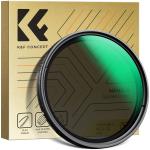
52mm Variable ND Filter ND2-ND32 (1-5 Stops) Lens Filter Waterproof Scratch Resistant with 24 Layers of Nano-coating Nano-Dazzle Series
SKU: KF01.2412
This adjustable ND filter is awesome! Make sure to get the right size for your camera, but you only need screw it on in front of the lens and turn the outer ring to adjust the brightness. The glass is perfect with no imperfections, the presentation is great, and the build quality is super solid. I definitely recommend picking up one of these for the convenience of being able to adjust to exactly the right filter strength you need rather than having to keep trying a bunch of other filters!
15/01/2026
ND filters are among the essential accessories in a photographer's bag because they allow you to take shots that would otherwise be impossible. Since most cameras do not allow you to go below 100 ISO, in good lighting conditions it is impossible to have enough shutter speeds to take photos that also capture movement.
In this case it is a variable filter, which can become more or less dark simply by rotating the front ring, continuously and not in steps. It therefore goes from a single reduction stop up to 5. This means that you can go from 1/80 of a second without a filter to 1/5, which is not a small amount at all.
The overall quality loses a bit in terms of sharpness and detail, but from my point of view not so much as to become annoying. Of course, I tried it with a Canon 6D which has a 20 megapixel sensor, with 24-105 F4 L, on cameras with higher resolution the result could be worse. Obviously the result is inferior to what you would get from a non-variable filter but the flexibility somehow comes at a price.
Even at 24 millimeters I did not notice vignetting which could however appear on shorter focal lengths given that the filter is not very thin.
The selling price seems more than adequate to me given that it allows you to save on the purchase of filters with different opacities.
In this case it is a variable filter, which can become more or less dark simply by rotating the front ring, continuously and not in steps. It therefore goes from a single reduction stop up to 5. This means that you can go from 1/80 of a second without a filter to 1/5, which is not a small amount at all.
The overall quality loses a bit in terms of sharpness and detail, but from my point of view not so much as to become annoying. Of course, I tried it with a Canon 6D which has a 20 megapixel sensor, with 24-105 F4 L, on cameras with higher resolution the result could be worse. Obviously the result is inferior to what you would get from a non-variable filter but the flexibility somehow comes at a price.
Even at 24 millimeters I did not notice vignetting which could however appear on shorter focal lengths given that the filter is not very thin.
The selling price seems more than adequate to me given that it allows you to save on the purchase of filters with different opacities.
09/01/2026
I must say that this type of all-in-one product is a good idea to avoid carrying around numerous filters and their boxes, which take up significant space in a bag.
The product here is well-finished, with no major flaws in the final image. I didn't notice any artifacts or particular blurring.
This filter replaces five ND filters: 2, 4, 8, 16, and 32. For the moment, it's adopted for my use. The build quality is very decent.
The product here is well-finished, with no major flaws in the final image. I didn't notice any artifacts or particular blurring.
This filter replaces five ND filters: 2, 4, 8, 16, and 32. For the moment, it's adopted for my use. The build quality is very decent.
08/01/2026
Quality filter, perfect fit for the 72mm lens. Enhances color and produces sharp images; very easy to adjust.
05/01/2026
no issues with my unit have used it a few times for shooting video outside at shallower apertures
04/01/2026
First of all:
If you're looking for maximum image quality, don't use any filter at all. Without exception, every filter has a negative impact on image quality. With good filters, this is acceptable, with bad ones, it's not.
If you want to take photos with maximum quality, you should always use a good "fixed" neutral density filter. Variable filters always have a slight influence on color; you can't circumvent physics in this case.
So, who is a variable filter suitable for?
Primarily if you're shooting videos (where you should observe the 180-degree rule) and you don't want or can't go through the hassle of changing filters. For example, when traveling, with family, etc., or simply because of the convenience.
In this context, the filter fully serves its purpose.
The feel, material appearance, rotating mechanism, and above all, the optical quality are all very good within the possible limits. The mechanical limitation of minimum and maximum darkening is extremely pleasant in practice. You know without looking that when the filter isn't actually needed, for example, for a photo, it's set to the minimum setting.
Because you don't really want to be constantly screwing filters on and off.
This is where the alternatives come into play:
Magnetic, non-variable ND filters. They can be put on and taken off quickly and easily and offer higher optical quality. However, they also cost considerably more.
One disadvantage of this filter is that you can't attach a front cap. Otherwise, the mechanical design would greatly increase vignetting, which is otherwise visible (Nikon 14-30), but remains within acceptable limits. Magnetic front caps, however, are obviously available for magnetic filters.
This filter is good; it's not a cheap filter, although it is much cheaper than a set of separate magnetic filters with fixed ND steps.
So before you buy, you should compare, and if separate filters are out of the question, this variable ND filter offers a really good alternative.
If you're looking for maximum image quality, don't use any filter at all. Without exception, every filter has a negative impact on image quality. With good filters, this is acceptable, with bad ones, it's not.
If you want to take photos with maximum quality, you should always use a good "fixed" neutral density filter. Variable filters always have a slight influence on color; you can't circumvent physics in this case.
So, who is a variable filter suitable for?
Primarily if you're shooting videos (where you should observe the 180-degree rule) and you don't want or can't go through the hassle of changing filters. For example, when traveling, with family, etc., or simply because of the convenience.
In this context, the filter fully serves its purpose.
The feel, material appearance, rotating mechanism, and above all, the optical quality are all very good within the possible limits. The mechanical limitation of minimum and maximum darkening is extremely pleasant in practice. You know without looking that when the filter isn't actually needed, for example, for a photo, it's set to the minimum setting.
Because you don't really want to be constantly screwing filters on and off.
This is where the alternatives come into play:
Magnetic, non-variable ND filters. They can be put on and taken off quickly and easily and offer higher optical quality. However, they also cost considerably more.
One disadvantage of this filter is that you can't attach a front cap. Otherwise, the mechanical design would greatly increase vignetting, which is otherwise visible (Nikon 14-30), but remains within acceptable limits. Magnetic front caps, however, are obviously available for magnetic filters.
This filter is good; it's not a cheap filter, although it is much cheaper than a set of separate magnetic filters with fixed ND steps.
So before you buy, you should compare, and if separate filters are out of the question, this variable ND filter offers a really good alternative.
02/01/2026
The range of flexibility provided by this filter is amazing. With a variation from ND2 to ND32, it offers an impressive 1-5 f-stops of light reduction, allowing precise control over exposure levels in varying lighting conditions. This adaptability has become an integral part of my photography gear, enabling me to achieve stunning creative effects and maintain the desired shutter speed even in bright environments. The 24 - layer coating on the filter is a testament to its high - quality construction. It effectively minimises reflections, ghosting, and flare, ensuring superb image clarity and colour accuracy. The build quality is excellent, and the filter feels robust and durable. Its waterproof feature adds an extra layer of protection, making it suitable for outdoor shoots in various weather conditions without compromising performance or risking damage. The 77mm diameter makes it compatible with various lenses, offering versatility across my photography equipment. The smooth rotation allows for quick and precise changes to the light reduction level, enabling seamless adjustments while shooting. This user - friendly design significantly enhances workflow efficiency, especially in fast - paced shooting scenarios.
29/12/2025
This variable ND filter is really practical for video or photography when shooting by the sea or river.
It's well-made, the screw thread has no flaws, and the variation between ND2 and ND32 is quite good; it's not too rapid.
I haven't noticed any color shift or vignetting. I use it with a Nikon Z6, the 50mm f1.8, and an adapter ring because the lens thread is 62mm.
It's well-made, the screw thread has no flaws, and the variation between ND2 and ND32 is quite good; it's not too rapid.
I haven't noticed any color shift or vignetting. I use it with a Nikon Z6, the 50mm f1.8, and an adapter ring because the lens thread is 62mm.
26/12/2025
It's certainly not the best, but it's fine for my use. So far, the ring turns smoothly, and the good thing is that it doesn't go all the way around. It doesn't make "X" shapes.
22/12/2025